
Editorial Disclosure
This independent comparison was prepared using publicly available information from official agency websites and reputable industry sources. Services, locations, positioning, and public pricing were reviewed on August 6, 2026. The agencies are presented in an editorially selected order based on relevance to the guide rather than as a definitive performance ranking. No agency paid for inclusion or influenced the editorial content.
B2B SaaS companies do not simply need more traffic. They need qualified pipeline, efficient customer acquisition, credible category positioning, strong activation, and marketing that supports retention and expansion. Those requirements make choosing among the best SaaS marketing agencies more complicated than comparing SEO rankings or ad-management fees.
SaaS marketing differs from traditional campaign marketing because revenue recurs over time. A team must understand annual recurring revenue, lifetime value, customer acquisition cost, payback periods, product-qualified leads, buying committees, long sales cycles, onboarding, churn, and expansion. The best partner therefore connects channel metrics to pipeline and revenue rather than reporting impressions and form fills in isolation.
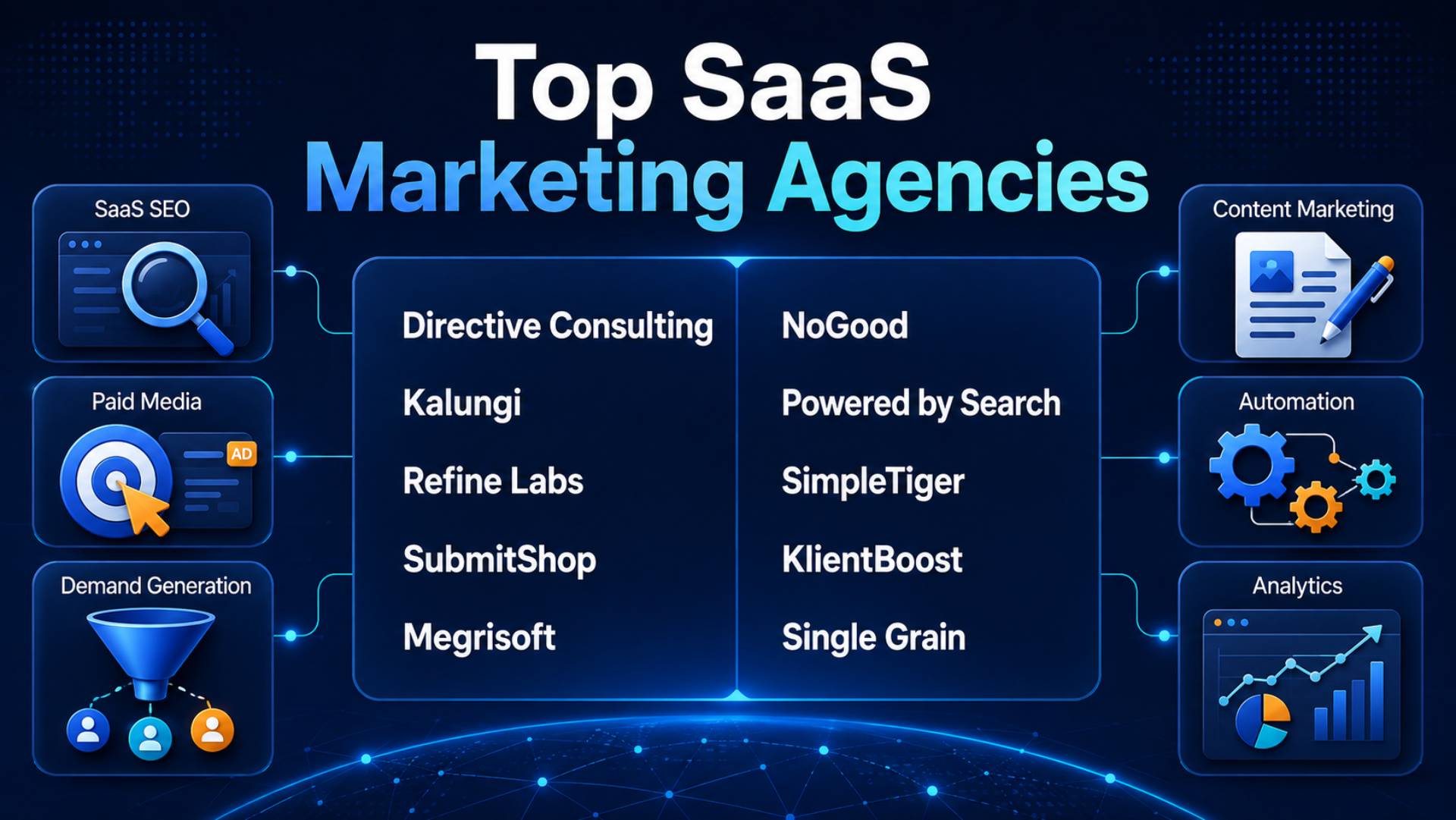
This buyer’s guide compares ten agencies in the order specified by the publisher. It examines verified services, public pricing, fit, limitations, and operational breadth. The rankings should be treated as a structured shortlist—not a universal league table—because an early-stage product-led company and a multinational enterprise need very different partners.
Key Takeaways
- Directive Consulting serves established B2B SaaS and technology companies through paid media, SEO, lifecycle, conversion, and revenue analytics services.
- Kalungi specializes in outsourced B2B SaaS marketing leadership and execution, particularly for early and growth-stage companies.
- Refine Labs focuses on demand generation for larger B2B SaaS companies; its stated qualification criteria and pricing exclude most startups.
- SimpleTiger specializes in SaaS SEO, while KlientBoost emphasizes PPC and conversion experimentation.
- SubmitShop and Megrisoft offer broad, globally delivered SEO and digital marketing capabilities, but buyers should request SaaS-specific references and define revenue reporting requirements during procurement.
- Public prices vary widely. Verified examples range from focused low-four-figure consulting to retainers above $30,000 per month. Media spend, software, creative production, and website development may be additional.
- The right agency depends on growth stage, average contract value, internal skills, market, budget, attribution maturity, and whether the company needs a specialist channel team or a complete outsourced function.
SaaS Marketing Agencies at a Glance
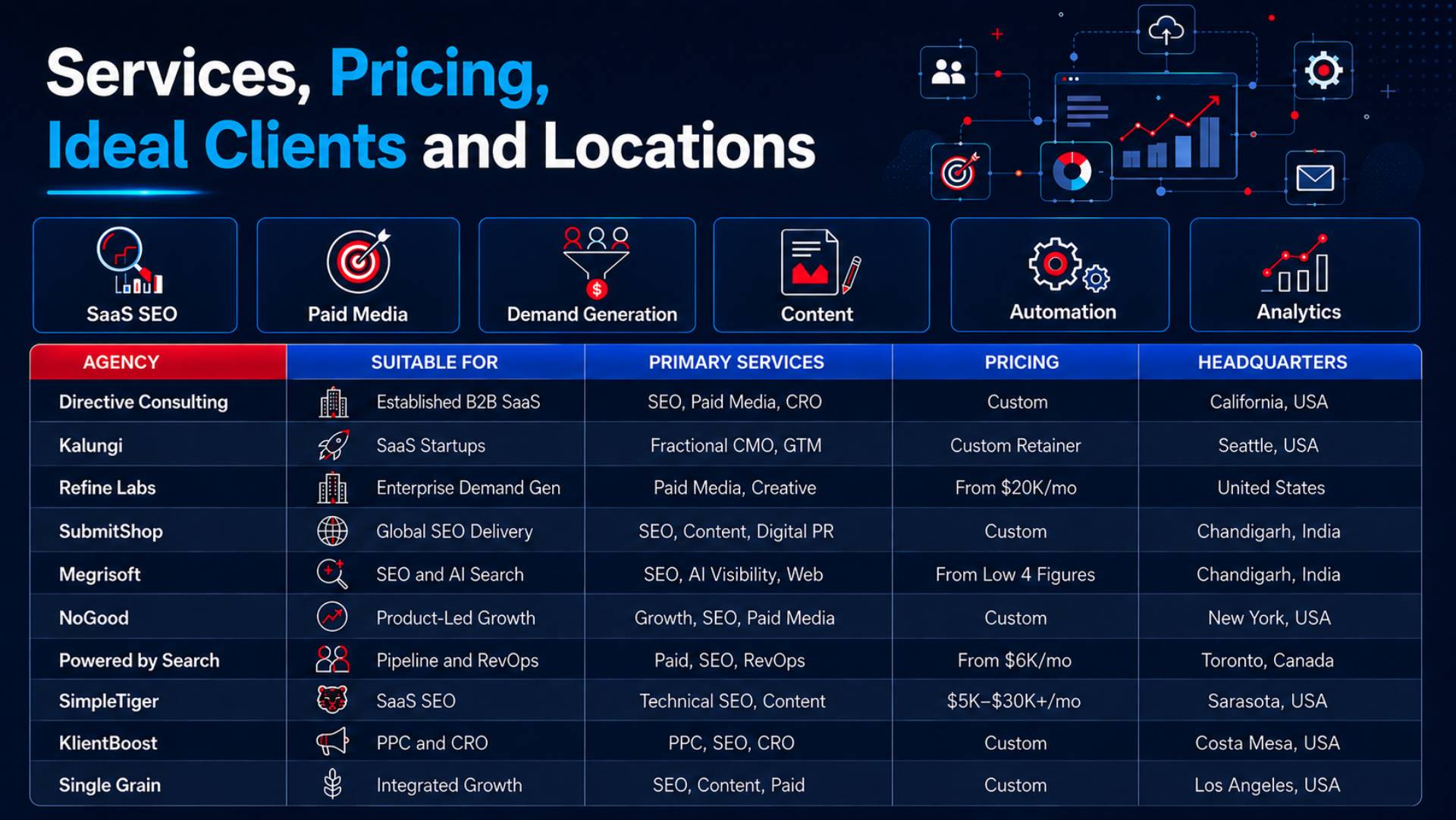
*Prices are agency-published as of the review date and may reflect specific services, billing terms, or qualification requirements rather than a complete engagement.
How We Evaluated These Agencies
We reviewed official service pages, public pricing, case-study evidence, specialization, ideal-client statements, and listed locations. We also examined current agency comparison pages to identify common information gaps. Many competing lists repeat agency claims without explaining fit, procurement risk, or the difference between SaaS specialization and general digital capability.
We assessed SaaS specialization, services, suitable client profile, public pricing, locations, and the depth of verifiable information available from official sources. Where price, office, or capability information was not found, it is marked as not publicly disclosed or treated cautiously. The order follows the publisher’s required list and is not a performance ranking.
1. Directive Consulting
SaaS specialization: Directive is a B2B and technology-focused performance marketing agency. Its SaaS offering spans paid media, SEO, conversion optimization, customer lifecycle marketing, and KPI and attribution strategy. This breadth makes it a practical candidate for companies that want acquisition channels connected to customer value and revenue reporting.
Ideal client: A suitable client is an established SaaS or technology company with meaningful budgets, an internal revenue team, and a need to coordinate multiple growth channels. Directive stands out because it addresses both demand capture and lifecycle performance rather than treating SEO, SaaS PPC, and analytics as isolated workstreams.
Core services: paid search and social, SaaS SEO, content, CRO, lifecycle marketing, creative, data and attribution.
Locations: the agency publicly lists Orange County, Austin, New York City, Mexico City, London, and Toronto.
Pricing: custom pricing available upon request.
Notable strengths: deep B2B technology positioning, wide service coverage, revenue-oriented measurement, and enterprise-ready strategy.
Potential limitations: a broad, sophisticated engagement may be excessive for a pre-revenue startup or a company needing only occasional content production.
Who should avoid it: very small teams seeking a low-cost single deliverable without ongoing strategic involvement.
2. Kalungi
SaaS specialization: Kalungi is built around B2B SaaS go-to-market execution. Its model combines fractional CMO leadership with a team that can execute positioning, content, demand generation, SEO, paid media, and marketing automation. Its official site describes full-service, collaborative “Syntropy,” and playbook-led engagement options.
Ideal client: This structure suits a funded startup or scale-up that has product-market evidence but lacks experienced marketing leadership and channel specialists. Kalungi can be more useful than a narrow agency when the immediate requirement is to build the marketing function itself.
Core services: fractional CMO, GTM strategy, positioning, product marketing, content, SEO/SEM, paid media, automation, and demand generation.
Headquarters: Seattle, Washington; its workforce is distributed.
Pricing: its FAQ confirms a retainer that may include a pay-for-performance component, but it does not publish a standard amount.
Notable strengths:SaaS-only positioning, integrated leadership and delivery, and suitability for companies building foundational systems.
Potential limitations: firms with a strong CMO and mature specialist teams may not need the outsourced-department model.
Who should avoid it: enterprises seeking only high-volume paid media operations or a small standalone technical SEO project.
3. Refine Labs
SaaS specialization: Refine Labs focuses on modern B2B demand generation, paid media, creative, pipeline analysis, and measurement. The agency says it has worked with more than 300 mid-market and enterprise B2B technology companies. Its qualification page targets organizations with substantial revenue and marketing spend, making its market position unusually clear.
Ideal client: Refine Labs is suited to Series B and later B2B SaaS companies that already invest in marketing but need to rethink demand creation, paid media efficiency, creative, and executive reporting. Its senior-practitioner model and willingness to challenge lead-volume thinking are differentiators.
Core services: demand strategy, paid media management, campaign planning, creative development, pipeline analysis, and board-ready reporting.
Offices: the company operates with a distributed US team; a conventional headquarters address is not prominently disclosed on the reviewed service pages.
Pricing: its pricing page lists a $35,000 assessment, full-service management from $31,000 per month, and paid media plus creative strategy from $20,000 per month.
Notable strengths: transparent fit criteria, published prices, focused demand expertise, and senior strategic involvement.
Potential limitations: limited emphasis on technical SEO and long-form organic content; high entry price.
Who should avoid it: early-stage startups, small advertising budgets, and companies primarily seeking SaaS SEO.
4. SubmitShop
SaaS specialization: SubmitShop is a broad digital marketing company and part of Megrisoft. It is not positioned as a SaaS-only agency, but its official site states that it works with SaaS and technology companies. Its capabilities include organic and technical SEO, paid search, content creation, link building, digital PR, lead generation, analytics, creative, and conversion optimization.
Ideal client: A suitable client is a SaaS company seeking flexible international delivery, search execution, content outreach, or link acquisition at a scope that can be customized. Its long operating history and broad channel menu are useful, but buyers should evaluate the exact proposed team and request relevant SaaS examples.
Core services: SEO, technical SEO, paid search, content, outreach, digital PR, CRO, lead generation, analytics, social, email, and web design.
Locations: SubmitShop lists New York, Toronto, London, and India; its operating base is associated with Chandigarh.
Pricing: custom pricing available upon request.
Notable strengths: broad organic-search services, international coverage, content distribution, and potentially flexible scope.
Potential limitations: SaaS specialization, standard pricing, and SaaS revenue-attribution methods are not documented as deeply as at dedicated SaaS agencies.
Who should avoid it: enterprises that require a proven SaaS-only demand-generation methodology without a detailed validation process.
5. Megrisoft
SaaS specialization: Megrisoft is an international digital marketing, web development, and technology services company rather than a specialist SaaS marketing boutique. Its relevant strengths include organic and technical SEO, AI-search visibility, content, paid advertising, social media, web design, development, and maintenance. This combination can appeal to software firms that need both acquisition and website delivery.
Ideal client: Megrisoft is suited to startups, established technology businesses, and international teams that want search and web services from one provider. Its AI-search offering covers audits, strategy, content, and visibility work, an increasingly relevant complement to conventional SaaS SEO.
Core services: SEO, technical audits, AI-search optimization, content, paid advertising, social media, web design, development, and maintenance.
Locations: the company lists its corporate office in Chandigarh, India, a Canadian office in Montreal, and international operations in London and the United States.
Pricing: the AI-search service states that focused audits and consulting generally start in the low four figures, retainers from the mid four figures monthly, and enterprise work is custom scoped. Other services require a quote.
Notable strengths: integrated technical and marketing delivery, global availability, search expertise, and public starting guidance for AI visibility.
Potential limitations: less public detail on a SaaS-specific demand-generation framework, paid media specialization, and product-led growth programs.
Who should avoid it: buyers insisting on a SaaS-only agency with extensive public enterprise SaaS case studies in every channel.
6. NoGood
SaaS specialization: NoGood describes itself as a growth marketing agency serving startups, scale-ups, and large brands. Its SaaS practice combines rapid experimentation, performance marketing, SEO, content, CRO, demand generation, and lifecycle thinking. It also emphasizes growth loops and product considerations, making it relevant for product-led growth.
Ideal client: A suitable client has reliable product data, enough traffic or media budget to test, and an appetite for fast experimentation. NoGood stands out for bringing creative, data, performance, and retention disciplines into a squad model.
Core services: growth strategy, AEO and SEO, paid search and social, content, community, CRO, lifecycle marketing, creative, analytics, and experimentation.
Locations: New York is its publicly identified base; the team operates globally.
Pricing: custom pricing available upon request.
Notable strengths: experimentation culture, product-led perspective, broad full-funnel skill set, and AI-search capability.
Potential limitations: a rapid-testing model needs sufficient data and internal product access; the agency is not a narrow technical SEO provider.
Who should avoid it: companies unable to supply analytics access, engineering support, testing volume, or clear growth ownership.
7. Powered by Search
SaaS specialization: Powered by Search focuses on B2B technology companies and connects paid media, organic demand, and revenue operations. This is a useful combination when weak CRM hygiene or attribution prevents a SaaS team from knowing which campaigns create pipeline.
Ideal client: The agency is suited to a growth-stage or enterprise B2B SaaS business with meaningful ad spend, an existing CRM, and a need to align marketing execution with lead routing, reporting, and revenue operations. Its public prices and defined packages reduce early procurement ambiguity.
Core services: paid media, SEO and LLM visibility, CRO and creative, fractional RevOps, CRM cleanup, lead scoring, routing, dashboards, and attribution.
Headquarters: Toronto, Canada.
Pricing: the official pricing page lists paid media from $6,000 per month, scale and enterprise tiers at higher levels, a $2,500 Power Hour, a $14,900 pipeline audit, and a $25,000 execution sprint. Quarterly billing can change displayed rates.
Notable strengths: transparent pricing, B2B SaaS pipeline focus, and integrated RevOps.
Potential limitations: likely unnecessary for a company without basic product-market fit or meaningful demand to capture.
Who should avoid it: pre-seed companies seeking inexpensive content production or branding alone.
8. SimpleTiger
SaaS specialization: SimpleTiger is a SaaS-focused search agency covering SEO, technical SEO, content production, link building, AI search, and PPC. Its specialization is valuable for software companies that already understand their market but need a focused organic-growth engine.
Ideal client: A suitable client is a B2B or B2C SaaS company seeking search revenue, technical remediation, content, and authority building from one specialist. Its narrower focus can also make responsibilities clearer than at a full-service agency.
Core services: SaaS SEO strategy, technical SEO, content, link building, AI-search visibility, paid search, and web design.
Headquarters: Sarasota, Florida.
Pricing: its SaaS SEO page provides an indicative range of $5,000 to $30,000 or more per month, depending on competition, scope, and goals.
Notable strengths: dedicated SaaS search expertise, technical capability, content and links under one program, and complementary PPC.
Potential limitations: not the first choice for fractional CMO leadership, brand campaigns, or broad enterprise demand transformation.
Who should avoid it: firms whose main constraint is sales operations, lifecycle automation, or non-search brand awareness.
9. KlientBoost
SaaS specialization: KlientBoost is a performance marketing agency with dedicated SaaS capability. Its SaaS services include PPC, retargeting, email, ABM, SEO, CRO, and demand generation. The agency’s combination of paid acquisition and landing-page experimentation is particularly relevant when click volume is healthy but demo or trial conversion is weak.
Ideal client: A suitable client has sufficient advertising budget and wants an execution-heavy partner that continually tests campaigns and conversion paths. KlientBoost works across industries, so SaaS buyers should confirm the assigned team’s software experience.
Core services: Google Ads, paid social, SaaS PPC, SEO, CRO, landing pages, email, retargeting, ABM, and demand generation.
Locations: Costa Mesa, California; Raleigh, North Carolina; and London, United Kingdom are publicly listed.
Pricing: custom pricing. Its Google Ads page cites a broad market range of $2,000–$15,000+ per month, while its own model varies by scope; the agency says it supports ad spend from $5,000 to more than $1 million monthly.
Notable strengths: paid media depth, conversion experimentation, creative volume, and multi-market delivery.
Potential limitations: broader industry coverage means SaaS specialization can vary by team; buyers requiring a complete outsourced marketing department may need other partners.
Who should avoid it: companies without proven demand, adequate media budget, or capacity to act on landing-page tests.
10. Single Grain
SaaS specialization: Single Grain is a broad digital marketing agency with a dedicated SaaS offering. It combines paid acquisition, SEO, content, CRO, and growth strategy. This makes it suitable for software businesses that want multiple digital channels coordinated but do not necessarily require a SaaS-only agency.
Ideal client: A suitable client is a growth-stage SaaS company seeking integrated digital acquisition, testing, and content support. Single Grain also publishes extensive educational material, which helps buyers evaluate its strategic perspective before contacting the team.
Core services: SaaS strategy, SEO, content, paid media, CRO, conversion testing, and growth consulting.
Headquarters: Los Angeles, California.
Pricing: Single Grain states that it creates custom proposals; no standard agency price is disclosed.
Notable strengths: broad digital capability, growth strategy, and integration of paid, organic, and conversion work.
Potential limitations: it is not exclusively B2B SaaS, and public package pricing is limited.
Who should avoid it: buyers wanting a narrow boutique specialist, a published fixed package, or a fully embedded fractional CMO.
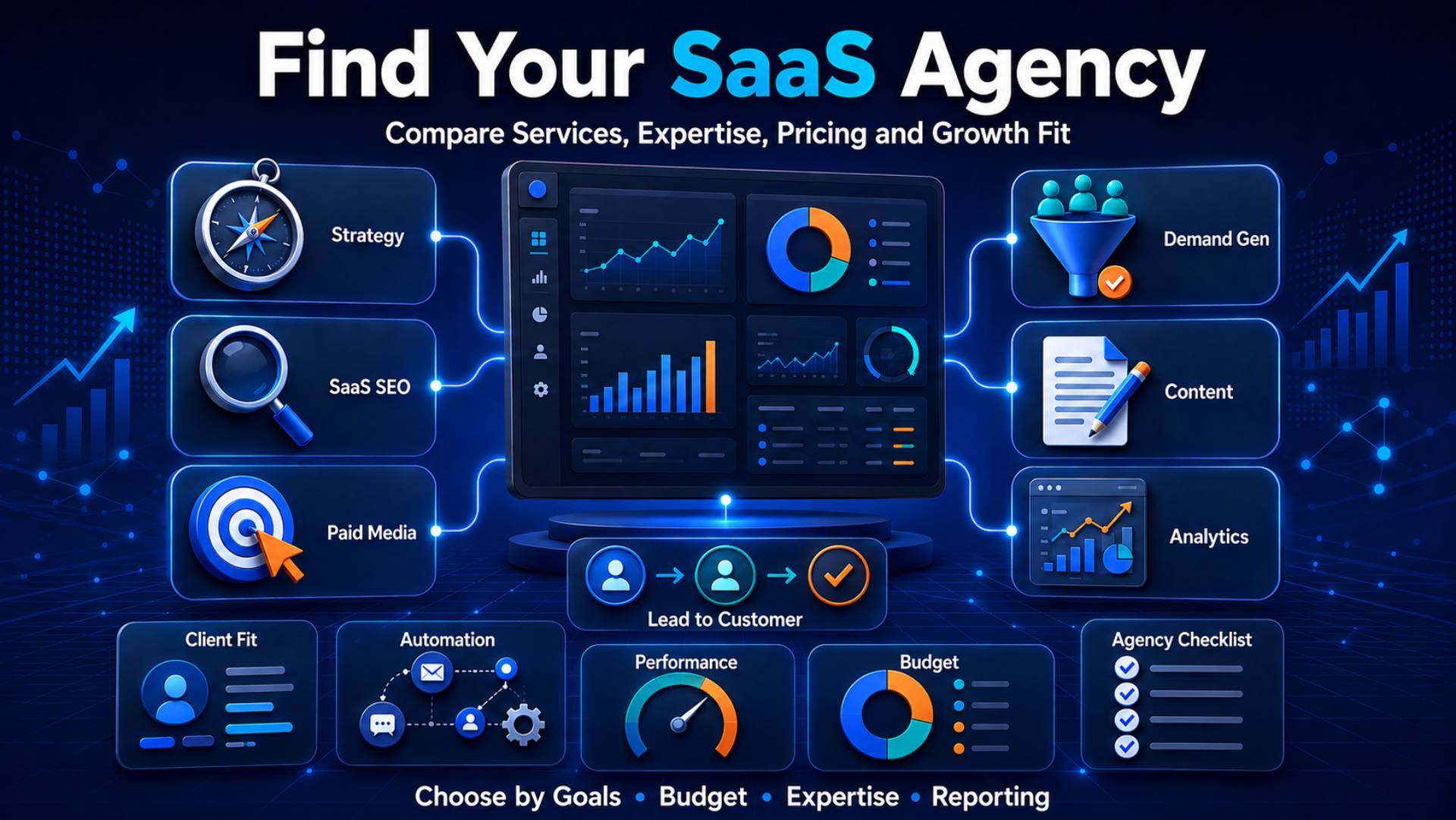
Which SaaS Marketing Agency May Fit Your Requirements?
| Requirement | Relevant agency | Verified basis for consideration |
| Integrated B2B SaaS marketing | Directive Consulting | Broad performance and lifecycle coverage |
| Startup marketing function | Kalungi | Fractional CMO plus execution team |
| Large-company demand programs | Refine Labs | Explicit focus on mid-market and enterprise B2B SaaS |
| SaaS SEO | SimpleTiger | Dedicated SaaS organic and technical specialization |
| Paid media | KlientBoost | PPC combined with conversion testing |
| Demand generation | Refine Labs | Strategy, media, creative, and measurement focus |
| Content and digital growth | Single Grain | Integrated content, SEO, and growth services |
| Technical SEO | SimpleTiger | Technical work is central to its SaaS SEO offer |
| Flexible global SEO delivery | SubmitShop | International search and content delivery; validate scope |
| Global marketing and web delivery | Megrisoft | India, UK, US, and Canadian presence with web capabilities |
| RevOps alignment | Powered by Search | Paid, organic, CRM, routing, and attribution integration |
| Product-led growth | NoGood | Experimentation, growth loops, lifecycle, and product focus |
Signs It Is Time to Hire an Agency
An agency becomes useful when the growth problem is clear but internal capacity or expertise is insufficient. Common signs include rising acquisition cost, weak attribution, stagnant qualified pipeline, technical SEO debt, inconsistent content, poor paid conversion, or a product launch that exceeds the team’s channel experience.
Hiring is also sensible when a company needs several specialists quickly. Recruiting an SEO lead, paid media manager, content strategist, marketing operations expert, designer, and analyst can take months. An agency can provide a coordinated team sooner, although the client must still supply product knowledge, approvals, data access, and accountable leadership.
Do not hire merely because growth is slow. If product-market fit, retention, pricing, or sales execution is fundamentally weak, more traffic can amplify the problem rather than solve it.
Common SaaS Marketing Services Explained
SaaS SEO targets problems, alternatives, use cases, integrations, comparisons, and category terms that match buyer intent.
Technical SEO addresses crawling, indexing, JavaScript rendering, internal links, structured data, duplication, migrations, and site performance.
SaaS PPC captures existing demand through search and reaches defined accounts or roles through paid social.
Demand generation creates awareness and preference before buyers are ready to complete a form, while
lead generation captures identifiable prospects. A mature program balances both instead of maximizing low-intent leads.
Content marketing supports education, category credibility, sales enablement, SEO, customer proof, and retention.
Revenue marketing connects campaigns to opportunities, recurring revenue, CAC, payback, and expansion.
Marketing automation manages scoring, routing, nurturing, lifecycle communication, and operational consistency.
Product-led growth uses the product experience to acquire, activate, convert, and expand users. It requires close cooperation among marketing, product, data, customer success, and sales; it is not simply a free-trial campaign.
How Much Does a SaaS Marketing Agency Cost?
Pricing depends on company stage, channel mix, geography, output volume, media budget, seniority, data complexity, and whether the agency supplies leadership or execution. Public examples in this review run from Megrisoft’s low-four-figure focused AI-search work to Refine Labs’ $31,000-per-month starting point for full-service management.
Common models include:
- Monthly retainer: a fixed recurring fee for a defined team and scope. This is the most common model for ongoing SEO, content, demand generation, and paid media.
- Project fee: a fixed price for an audit, strategy, website, migration, launch, or implementation sprint.
- Consulting or fractional leadership: time- or outcome-bounded access to senior strategy without a full execution team.
- Percentage of media spend: a paid-media fee that scales with advertising spend, sometimes combined with a minimum base retainer.
- Performance component: compensation linked to agreed outcomes. Attribution rules, sales influence, quality controls, and data ownership must be explicit.
- Enterprise engagement: custom teams, regions, governance, BI integrations, security reviews, and executive reporting.
Ask what is excluded. Advertising spend, CRM licenses, third-party data, analytics tools, freelance production, travel, website development, and sales enablement may sit outside the quoted fee.
Questions to Ask Before Hiring
- Which clients had a similar ACV, sales cycle, market, and growth stage?
- Who will work on the account after the sales process, and how much senior time is included?
- Which metrics will connect activity to pipeline, revenue, CAC, payback, and retention?
- What must our internal team provide, and how many approval hours are expected each week?
- How are strategy, media, content, creative, SEO, and RevOps coordinated?
- Who owns accounts, data, pixels, creative files, landing pages, and documentation?
- What are the minimum term, notice period, renewal mechanism, and exit process?
- Which results are realistic in 30, 90, and 180 days, and what assumptions support them?
- How does the agency use AI, and what human review, confidentiality, and data controls apply?
- Can the agency provide references for the exact team and services proposed?
Red Flags to Watch For
Be cautious of guaranteed rankings, guaranteed pipeline without documented assumptions, vague proprietary methods, and case studies that omit time frames or starting conditions. A polished sales deck cannot replace access to the delivery team and a written measurement plan.
Other warning signs include reporting only impressions and MQLs, refusing to work in client-owned accounts, unclear subcontracting, mass-produced content without expert review, link schemes, no change-control process, and a contract that makes data or asset transfer difficult. An agency should also be willing to say when the limiting factor is product, pricing, sales follow-up, or retention rather than marketing.
In-House Team vs. SaaS Marketing Agency
| Factor | In-house team | SaaS marketing agency |
| Cost | Salaries, benefits, recruitment, management, tools | Retainer or project fee; extras must be defined |
| Expertise | Deep product and organizational knowledge | Wider specialist and cross-client experience |
| Hiring | Slow and role-dependent | Faster access to a formed team |
| Scalability | Requires recruitment or contractors | Scope can often expand or contract |
| Technology | Company buys and manages tools | Agency may bring methods and tool familiarity |
| Flexibility | Priorities can change internally | Changes may require scope and fee adjustments |
| Speed | Fast after team is established | Faster initial capacity; onboarding still required |
| Long-term ROI | Builds durable internal knowledge | Can accelerate learning but creates dependency risk |
The strongest model is often hybrid: an internal leader owns positioning, product knowledge, priorities, and revenue accountability while an agency supplies specialist execution and outside pattern recognition.
SaaS Marketing Trends to Watch in 2026
AI-search visibility is becoming part of search strategy. Buyers use AI answers alongside conventional search, so teams increasingly monitor brand citations, entity clarity, source authority, and answer-ready content. This does not eliminate technical SEO or original research; it increases their importance.
Pipeline quality is replacing lead volume as the central performance argument. Directive’s current SaaS guidance emphasizes ARR, NRR, and payback, while Refine Labs focuses on separating demand creation from demand capture. Both reflect a wider move toward revenue evidence instead of vanity metrics.
First-party data and RevOps hygiene matter more. Fragmented CRM stages, poor lead routing, and inconsistent campaign tagging make optimization unreliable. Agencies such as Powered by Search now package CRM cleanup, lifecycle automation, and attribution alongside acquisition.
Creative and media operations are converging. Paid teams need faster creative testing across LinkedIn, search, video, Meta, Reddit, and connected TV. Refine Labs explicitly embeds creative with paid media so performance feedback influences production.
Human expertise becomes a differentiator in AI-assisted content. Efficient drafting is widespread; original customer insight, expert commentary, proprietary data, credible bylines, and editorial controls are harder to copy. Buyers should ask agencies how AI is used and how factual, legal, and brand review is maintained.
How to Choose an Agency in Five Steps
1. Define the commercial constraint
Choose one primary problem: insufficient qualified pipeline, weak conversion, expensive paid acquisition, low organic visibility, poor activation, unclear positioning, or broken attribution. Do not begin with a list of channels.
2. Set the economic and operational boundaries
Document the total budget, media spend, ACV, sales cycle, target market, internal owners, technology, risk constraints, and decision timeline. Establish what success must be worth before comparing fees.
3. Shortlist by operating model
Decide whether you need fractional leadership, a full-service team, a search specialist, paid media and CRO, demand transformation, or RevOps support. Remove agencies whose minimum client profile does not match your stage.
4. Validate evidence and team fit
Review comparable case studies, speak with references, meet the proposed delivery lead, inspect a sample report, and ask the agency to diagnose a real problem. Score the same criteria for every finalist.
5. Contract around learning and accountability
Define the first 90 days, deliverables, access, KPIs, decision rights, meeting cadence, ownership, security, AI policy, termination, and handover. A limited audit or sprint can reduce risk before a long retainer.
What to Expect During the First 90 Days
| Period | Expected work | Useful outputs |
| Days 1–30 | Discovery, stakeholder interviews, data access, market and customer research, channel and tracking audits | Baseline, risk register, ICP, measurement plan, prioritized roadmap |
| Days 31–60 | Strategy approval, tracking fixes, campaign builds, technical changes, content and creative production | Live dashboards, corrected tracking, initial campaigns, content briefs, test backlog |
| Days 61–90 | Reporting, optimization, budget shifts, conversion tests, sales feedback, next-quarter planning | Early signal review, experiment results, pipeline analysis, scale/stop decisions |
SEO and content may show technical and ranking progress within 90 days, but competitive organic growth generally takes longer. Paid media can produce faster signals, although reliable revenue conclusions must account for the full sales cycle. The agency should distinguish implementation milestones from commercial outcomes.
Common SaaS Marketing Technology Stack
CRM: Salesforce and HubSpot store account, contact, opportunity, and lifecycle data. Automation: HubSpot, Marketo, Pardot/Marketing Cloud Account Engagement, and Customer.io orchestrate nurture and lifecycle communication.
Analytics: GA4, Amplitude, Mixpanel, and product data warehouses measure acquisition and behavior.
SEO: Google Search Console, Semrush, Ahrefs, Screaming Frog, and enterprise crawlers support visibility, keyword, link, and technical analysis.
PPC: Google Ads, Microsoft Advertising, LinkedIn Campaign Manager, Meta Ads, and other platforms manage demand capture and paid distribution.
Attribution: Dreamdata, HockeyStack, Factors.ai, and warehouse models help connect touches to pipeline, but no tool removes the need for consistent CRM processes.
Reporting: Looker Studio, Tableau, Power BI, and Looker present performance to operational and executive users.
Customer data: Segment, RudderStack, and warehouse-based pipelines unify events and identities. The right stack is the smallest one that produces trustworthy decisions; more tools do not repair weak definitions or ownership.
Final Verdict
There is no single suitable agency for every buyer among the best SaaS marketing agencies. Directive Consulting provides coordinated acquisition, lifecycle, conversion, and analytics services for established B2B SaaS firms. Kalungi’s model is designed for startups and scale-ups that need fractional leadership plus marketing execution. Refine Labs explicitly focuses on demand generation for larger B2B SaaS companies, subject to its budget and maturity requirements.
SimpleTiger specializes in SaaS SEO and technical SEO. KlientBoost focuses heavily on PPC and conversion optimization. NoGood serves product-led and experiment-ready teams. Powered by Search combines paid media and organic demand with CRM hygiene and attribution. Single Grain offers digital and content services. SubmitShop and Megrisoft provide globally delivered search and digital execution, although buyers should validate SaaS-specific references and revenue reporting during procurement.
The final decision should reflect objectives, budget, growth stage, internal capabilities, target geography, preferred working model, and the quality of the actual people assigned. Select the agency that can explain the constraint, show relevant evidence, define measurement, and leave the company with stronger systems—not merely a longer activity report.
FAQs
What is a SaaS marketing agency?
A SaaS marketing agency helps subscription software companies acquire, activate, retain, and expand customers. Depending on its specialty, it may provide positioning, demand generation, SEO, paid media, content, CRO, lifecycle automation, analytics, product-led growth, or revenue operations.
How is B2B SaaS marketing different from traditional marketing?
B2B SaaS marketing supports recurring revenue, long sales cycles, buying committees, product activation, retention, and expansion. Performance must be evaluated through metrics such as qualified pipeline, CAC, payback, lifetime value, recurring revenue, and retention—not only initial transactions or leads.
How much should a SaaS company budget for an agency?
There is no universal minimum. Public prices in this comparison range from low-four-figure focused consulting to more than $30,000 per month for full-service enterprise work. Set a total budget that includes the agency fee, media, software, production, implementation, and internal time.
Which agency is best for an early-stage SaaS startup?
Kalungi is the clearest fit when a funded startup needs fractional CMO leadership and execution. NoGood may suit product-led companies with enough data to experiment. SubmitShop or Megrisoft may suit narrower, value-conscious search projects. Pre-product-market-fit businesses may need positioning or customer research before scaled acquisition.
Which agency is best for enterprise SaaS marketing?
Refine Labs is highly focused on mid-market and enterprise B2B demand generation, while Directive offers broader enterprise SaaS performance capabilities. Powered by Search is relevant when RevOps and attribution are central. Procurement should still assess security, regions, governance, integrations, and the proposed team.
Which SaaS marketing agency is best for SEO?
SimpleTiger is the strongest SaaS SEO specialist in this list. Directive is a strong choice when SEO must integrate with paid media, lifecycle, and revenue strategy. Megrisoft is worth considering for technical SEO and AI-search visibility with international web support.
How long does it take to see results?
Paid campaigns can produce directional data within weeks, but revenue evaluation depends on the sales cycle. Technical fixes may be implemented quickly, while SEO and content usually require several months to compound. The first 90 days should establish trustworthy baselines, launch priority work, and generate early learning.
Should a SaaS company hire a specialist or full-service agency?
Choose a specialist when the bottleneck is clearly defined and internal leadership can coordinate the work. Choose a full-service agency when several functions must be built or integrated. A hybrid arrangement often provides the best balance of product knowledge, strategic ownership, and specialist capacity.
What KPIs should a SaaS marketing agency report?
Useful KPIs include qualified pipeline, opportunities, win rate, CAC, payback, recurring revenue, activation, retention, expansion, channel conversion, and sales-cycle velocity. Channel indicators such as rankings, clicks, engagement, and cost per lead remain useful, but they should connect to commercial outcomes.
Can an agency guarantee SaaS growth?
No credible agency can control product quality, pricing, competition, sales execution, market conditions, or retention. It can guarantee defined work, governance, and reporting standards, but commercial forecasts should state assumptions and ranges rather than promise certain revenue or rankings.
Last reviewed: August 6, 2026
Next recommended review: November 2026
Pricing market: Primarily United States; agency billing and taxes may vary by market
Pricing basis: Public agency pages, excluding media spend, taxes, software, and unlisted add-ons unless state
